
Article · 4 Feb 2025
Breaking Down the Blend: How Does Chemical Recycling Work?
In our last article, we explored why blended fibres make sock recycling so difficult, and why chemical recycling holds so much promise. This time, we're getting into the detail — the specific technologies being developed to finally crack the blended textile problem.
Why Blends Are So Hard to Crack
A typical sock might contain cotton for breathability, polyester for durability, nylon for stretch, and elastane to hold its shape. Each of those fibres is useful. Each of them has value. And each of them requires a completely different recycling process. The challenge isn’t recycling any one of them — it’s that they’re locked together, and pulling them apart without destroying them in the process is genuinely hard.
Mechanical recycling — the industry’s workhorse — simply shreds the fabric back into fibre. It works well for single-material textiles, but with blends you just end up with a tangled mixture of different fibres, degraded in quality and limited in what it can become. To truly recover the value in blended textile, you need to go deeper.
The Chemical Toolkit
Several chemical approaches are now being developed and refined, each tackling the problem from a different angle.
Solvent-based processes use targeted chemicals to dissolve one fibre type while leaving the others intact. In a cotton-polyester blend, for instance, a solvent might dissolve the polyester entirely, leaving clean cotton fibres behind — and the dissolved polyester can be recovered separately and rebuilt into new material. It’s selective, precise, and increasingly viable.
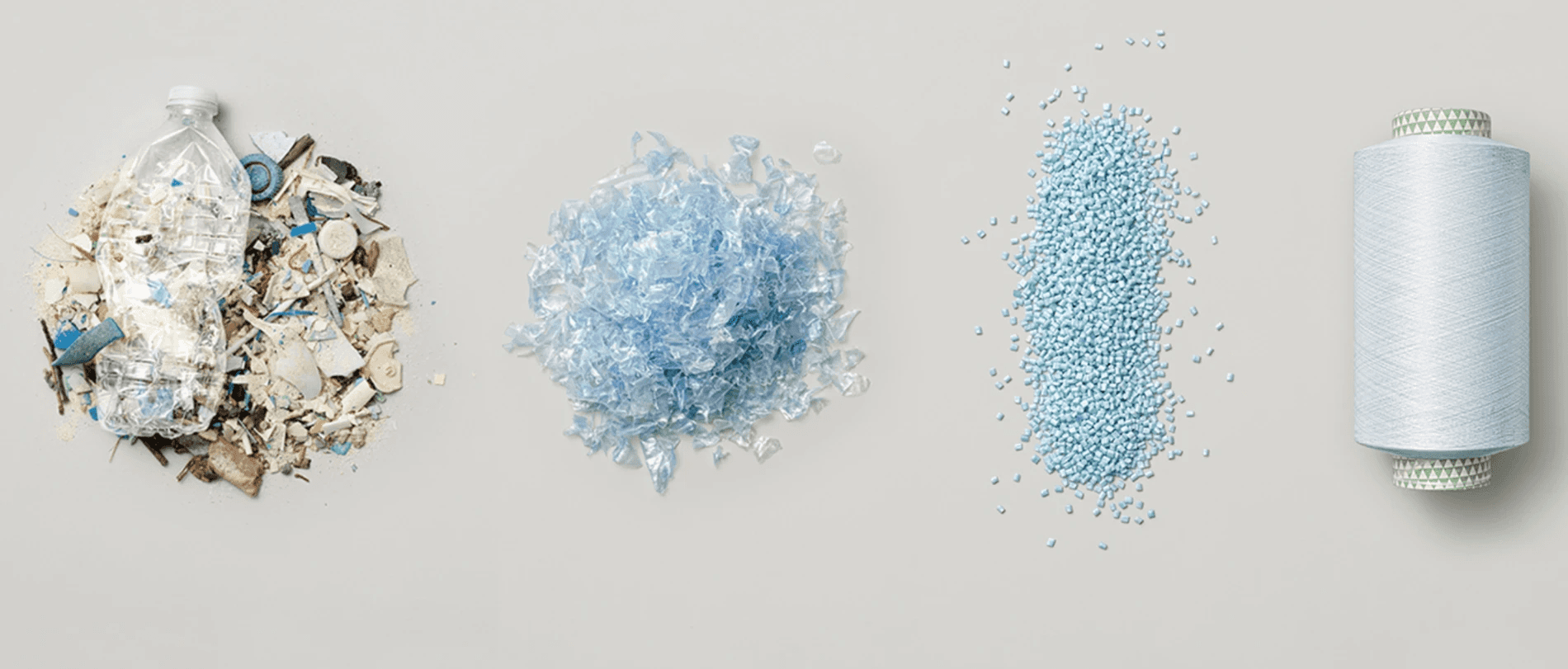
Depolymerisation goes even further for synthetic fibres. Rather than just dissolving polyester, it breaks it all the way down to its chemical monomers — the basic units from which the polymer was originally built. Those monomers can be purified and re-polymerised into virgin-quality polyester fibre, indistinguishable from newly manufactured material. No quality loss.
Thermal decomposition uses heat rather than chemistry to break down synthetic fibres, reducing them to their base components for reuse. It’s particularly useful for certain synthetic blends where chemical solvents aren’t practical.
Enzymes: Nature’s Answer to the Problem
One of the most exciting developments in textile recycling is enzymatic processing — and it’s worth understanding because it’s genuinely different from anything that came before.
Enzymes are biological molecules that break down specific substances with remarkable precision. Researchers have identified enzymes that target cellulose — the molecular structure of cotton — and can dissolve it completely while leaving synthetic fibres like polyester entirely untouched. The result is clean polyester recovery from a cotton-polyester blend, achieved not with aggressive industrial chemicals but with biology.
It’s still an emerging technology, but its precision and relatively low environmental impact make it one of the most promising directions in the field.
Knowing What You’re Dealing With
Before any recycling process can begin, the machinery needs to know exactly what it’s working with. This is where material identification technology comes in. Near-infrared spectroscopy — NIR — can scan a textile and identify its fibre composition almost instantly, without any physical testing. It reads the way different materials absorb light, producing a precise breakdown of what’s in the blend.
This might sound like a small detail, but it’s foundational. Automated sorting at scale is only possible when the system can reliably identify materials at speed. NIR is already used in plastics recycling, and its application to textiles is advancing quickly.
A Field That’s Moving Fast
What’s most striking about textile recycling right now is the pace of change. Five years ago, chemical recycling of blended textiles was largely theoretical. Today, pilot facilities are operating across Europe and Scandinavia, investment is flowing in, and several of these technologies are on the cusp of scaling commercially.
The blended fibre problem isn’t solved yet — but it’s closer to being solved than it has ever been. And as these technologies mature, the case for putting your old socks in textile waste rather than the bin becomes stronger with every passing year.